
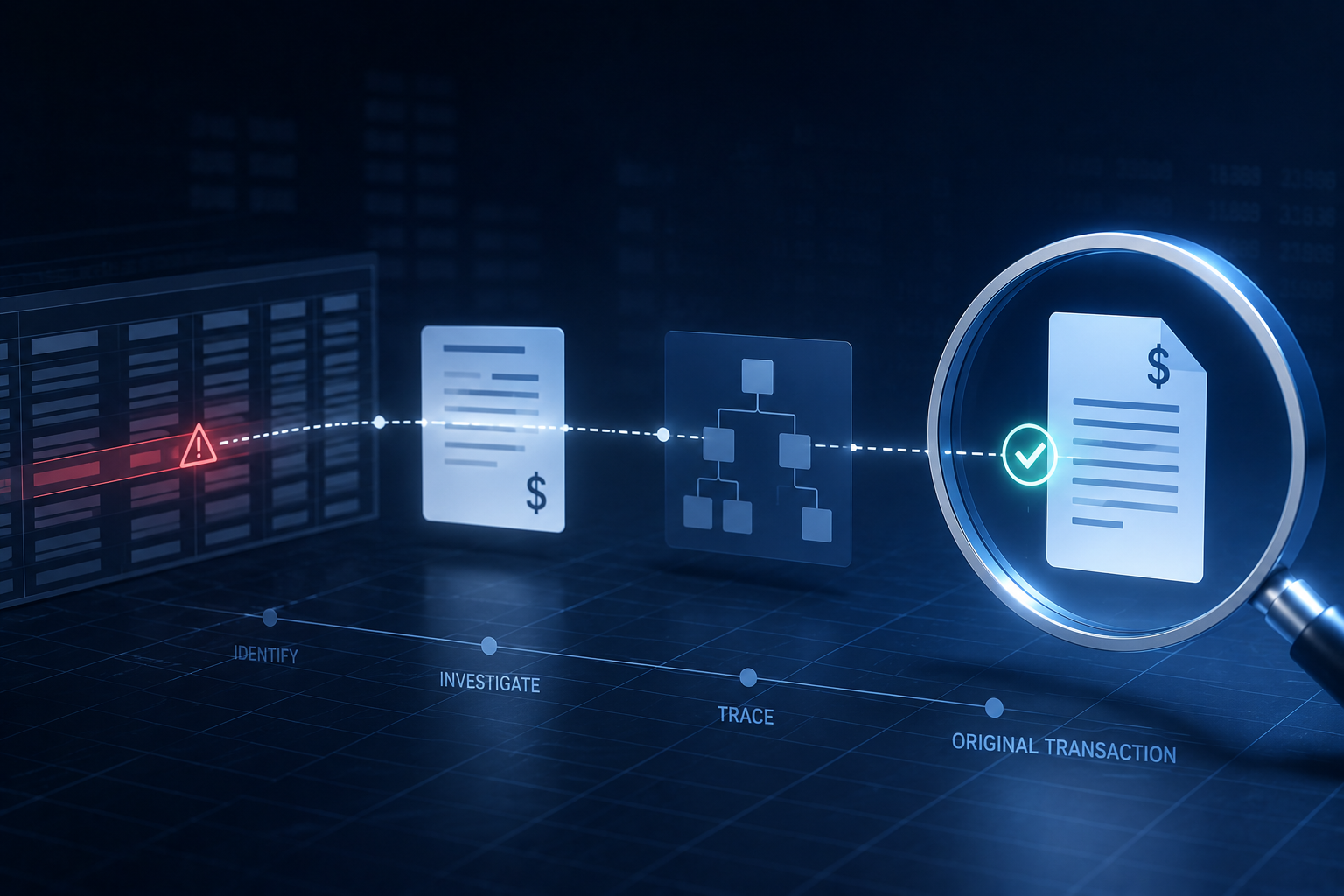
How Accountants Trace an Error Back to Its Original Transaction
Accounting errors can appear in almost any part of a company’s financial records. A bank balance may not agree with the cash account, an account reconciliation may contain an unexplained difference, a trial balance may fail to balance, or a financial report may show an amount that simply does not look right. While modern accounting software has reduced many manual mistakes, errors can still occur through incorrect data entry, duplicate transactions, posting mistakes, omitted entries, incorrect account classifications, timing differences, and problems caused by imported or automated data. When an error is discovered, accountants do not usually begin by randomly changing numbers until the records appear correct. Instead, they follow a structured process to trace the problem backwards through the accounting system until they identify the original transaction or event that caused it. This process is often similar to financial detective work. The accountant starts with the visible symptom of the problem, gathers evidence, narrows down the possible causes, reviews supporting documentation, and follows the audit trail back to the original source. Understanding how this process works can help business owners appreciate why accurate bookkeeping, clear documentation, reconciliations, and internal controls are so important.
Why Tracing Accounting Errors Matters
An accounting error is not always just a minor inconvenience. Even a relatively small mistake can affect account balances, financial reports, tax calculations, cash flow information, budgets, management decisions, and relationships with suppliers or customers. For example, a payment entered twice could overstate expenses and understate cash. An invoice posted to the wrong customer account could create confusion during accounts receivable collection. A transaction recorded in the wrong accounting period could distort monthly performance. If an error is not identified and corrected, the incorrect information may continue flowing through reports and affect future decisions. Tracing an error back to its original transaction helps ensure that the underlying cause is corrected rather than simply adjusting the visible result. This distinction is important. If an accountant only changes an account balance without understanding why the balance became incorrect, the same error may occur again.
A structured investigation can help businesses:
- Identify the original source of an accounting discrepancy.
- Correct inaccurate financial records.
- Prevent the same mistake from happening again.
- Maintain a reliable audit trail.
- Improve internal accounting procedures.
- Reduce the risk of duplicate, omitted, or incorrectly classified transactions.
- Produce more accurate financial reports.
- Support better management and business decisions.
For businesses that need help maintaining accurate records and reviewing financial activity, working with an experienced accounting professional can provide an additional level of oversight. Lampkin CPA Advisors provides accounting and advisory services designed to help businesses better understand and manage their financial information.
The Starting Point: Identifying the Symptom of the Error
Accountants often do not immediately know where an error occurred. What they see first is usually a symptom. The symptom could be an account balance that appears unusually high or low, a reconciliation difference, a missing transaction, an unexpected variance, or a financial statement amount that does not make sense when compared with previous periods. For example, imagine that a company’s cash ledger shows a balance of $52,400, while the reconciled bank balance should be $50,900. The accountant now knows that there is a $1,500 difference, but the difference itself does not explain what caused the problem. The investigation begins by defining exactly what is wrong.
Questions Accountants Ask at the Beginning
Before searching through hundreds or thousands of transactions, an accountant may ask several important questions:
- What account contains the discrepancy?
- How large is the difference?
- When did the difference first appear?
- Is the problem isolated to one account or affecting multiple accounts?
- Does the amount match a known transaction or recurring payment?
- Did the discrepancy appear after a particular process, import, adjustment, or reconciliation?
- Is the issue related to timing, classification, duplication, or omission?
These questions help transform a vague problem into a specific investigation. The more clearly the accountant defines the symptom, the easier it becomes to trace the error through the accounting records.
Step One: Determine When the Error First Appeared
One of the most useful techniques in tracing an accounting error is determining when the records were last known to be correct. Suppose a company’s accounts receivable balance was accurate at the end of March but contained an unexplained difference at the end of April. Instead of reviewing the company’s entire accounting history, the accountant can initially focus on transactions recorded during April. This approach significantly reduces the amount of information that needs to be reviewed.
Accountants may compare:
- Month-end account balances.
- Previous reconciliations.
- Bank statements.
- Prior financial reports.
- General ledger activity.
- Trial balances.
- Supporting schedules.
The goal is to establish a time boundary. Once the accountant identifies the point at which the numbers changed from correct to incorrect, the search becomes much more focused. This is one reason regular reconciliations are so valuable. If accounts are reviewed only once per year, an error may require the investigation of twelve months of transactions. If accounts are reconciled monthly or more frequently, the search period can be much smaller.
Step Two: Quantify the Difference
The size and characteristics of a discrepancy can provide important clues about its origin. For example, if an account is off by exactly $250, an accountant may search for transactions, invoices, checks, or journal entries with that amount. If the difference is $500, the accountant may consider whether a $250 transaction was duplicated. Sometimes the number itself reveals a possible pattern.
Common Numerical Clues
- An exact transaction amount: The difference may match an invoice, payment, or journal entry.
- Twice a known amount: A transaction may have been entered twice.
- Half of a known amount: A partial posting or incorrect split may have occurred.
- A rounded number: The error may involve a manual adjustment or estimate.
- A difference divisible by a particular amount: Several similar transactions may have been omitted or duplicated.
- A difference with unusual digits: A transposition or data-entry mistake may be involved.
For instance, a discrepancy of $5,400 may immediately prompt an accountant to search for transactions around that amount. A discrepancy of $10,800 could suggest that a $5,400 transaction was recorded twice. Quantifying the difference does not always solve the problem immediately, but it gives the investigation a measurable starting point.
Step Three: Review the General Ledger
The general ledger is one of the most important tools available when tracing an accounting error. It contains the detailed activity affecting each account. Once an accountant identifies the account containing the discrepancy, they can review the transactions posted to that account during the relevant period.
The accountant may look for:
- Unusual transaction amounts.
- Duplicate entries.
- Missing reference numbers.
- Unexpected journal entries.
- Transactions posted on unusual dates.
- Entries made by different users.
- Adjustments made near the end of the reporting period.
- Transactions posted directly to an account that is normally updated through another process.
Modern accounting systems often allow transactions to be filtered by date, amount, account, vendor, customer, transaction type, or user. These filters can help accountants quickly narrow down a large number of entries. For example, if an expense account suddenly increased significantly in one month, the accountant can compare the current month’s detailed ledger activity with the previous month. A single unusually large transaction may immediately stand out.
Step Four: Follow the Audit Trail
Once a suspicious transaction is identified, the next step is to follow the audit trail. An audit trail is the documented path showing how a transaction moved from its original source into the accounting records. Depending on the accounting system and the nature of the transaction, this trail may include invoices, purchase orders, receipts, payment records, bank activity, journal entries, approvals, and supporting documents.
For example, a purchase transaction might follow this path:
- A purchase order is created.
- The goods or services are received.
- A supplier invoice is entered.
- The invoice is approved.
- The transaction is posted to the appropriate expense or asset account.
- A payment is made.
- The payment appears on the bank statement.
If the accountant discovers an incorrect expense entry, they can move backwards through this chain to determine exactly where the error occurred. Perhaps the supplier invoice was entered incorrectly. Maybe the invoice was correct, but the transaction was posted to the wrong account. Alternatively, the original transaction may have been entered correctly but duplicated during an import or payment process. Following the audit trail allows the accountant to identify the source rather than merely correcting the final balance.
Step Five: Compare the Accounting Record With the Source Document
A source document provides evidence that a transaction occurred. Depending on the transaction, this may include an invoice, receipt, bank statement, contract, payroll record, sales document, or other supporting information. When an accountant suspects that a transaction was recorded incorrectly, they compare the accounting entry against the original documentation.
Important details may include:
- Transaction date.
- Amount.
- Vendor or customer name.
- Description of the transaction.
- Payment method.
- Account classification.
- Tax treatment.
- Reference or invoice number.
Consider a situation where an equipment purchase of $12,000 was recorded as a routine operating expense. The amount in the accounting system may match the invoice, but the classification may be incorrect. Reviewing the source documentation helps the accountant understand the nature of the purchase and determine whether the transaction should have been recorded differently. This illustrates an important point: not every accounting error involves the wrong number. Sometimes the amount is correct, but the date, account, customer, vendor, tax treatment, or classification is wrong.
Step Six: Use Reconciliations to Narrow Down the Problem
Reconciliations are among the most effective tools accountants use to identify and trace errors. A reconciliation compares two related sets of records to confirm that they agree or to explain why they differ. Bank reconciliations are the most familiar example, but many other accounts can also be reconciled.
Accountants may reconcile:
- Bank accounts.
- Accounts receivable.
- Accounts payable.
- Payroll liabilities.
- Sales records.
- Inventory records.
- Credit card accounts.
- Loan balances.
- Fixed asset schedules.
If a reconciliation identifies a difference, the accountant can compare the transactions on both sides. Transactions that appear in one record but not the other become potential sources of the discrepancy. For example, a payment may appear in the company’s accounting records but not on the bank statement. This could be a legitimate timing difference, such as an outstanding check, or it could indicate that the payment was recorded incorrectly.
Regular reconciliation makes it easier to isolate errors before they become larger problems. Businesses seeking assistance with maintaining reliable financial records can also explore the services offered by Lampkin CPA Advisors.
Step Seven: Look for Common Error Patterns
Experienced accountants understand that accounting mistakes often follow recognizable patterns. Identifying the type of error can make it much easier to locate the original transaction.
Duplicate Transactions
A duplicate transaction occurs when the same financial event is recorded more than once. This can happen when an invoice is entered twice, a bank transaction is imported multiple times, or a payment is recorded manually and then imported automatically.
Signs of duplicate transactions may include:
- Two identical or nearly identical amounts.
- Transactions recorded on the same or similar dates.
- Matching vendor or customer information.
- Duplicate invoice numbers.
- Unusual increases in expenses or revenue.
Omitted Transactions
An omitted transaction occurs when a financial event happened but was never recorded in the accounting system. An accountant may identify an omission by comparing source documents, bank activity, invoices, or external statements with the general ledger. For example, a bank statement may show a monthly service charge that does not appear in the accounting records. By tracing the discrepancy back to the bank activity, the accountant can identify the missing transaction.
Transposition Errors
A transposition error occurs when digits are entered in the wrong order. For example, $4,563 may be entered as $4,653. These errors can sometimes create numerical differences that follow recognizable patterns, helping accountants narrow their search.
Posting to the Wrong Account
A transaction may have the correct amount but be recorded in the wrong account. This type of error may not cause the trial balance to become unbalanced because the debit and credit sides may still be equal.Instead, the problem may become visible when management reviews financial statements and notices an unusual increase or decrease in a particular account.
Timing Errors
A transaction may be recorded in the wrong accounting period. This can affect monthly or annual financial reports even when the transaction amount and account classification are correct.Accountants often investigate timing errors by reviewing transaction dates, invoice dates, payment dates, and the accounting period in which the transaction was posted.
Incorrect Journal Entries
Manual journal entries can be necessary for adjustments, accruals, corrections, and other accounting processes. However, they can also create errors if the wrong account, amount, date, or description is used. When investigating an unexplained balance, accountants often review manual journal entries separately because these transactions may bypass the normal processes used for invoices, payments, or bank feeds.
Step Eight: Work Backwards Through Related Accounts
Accounting transactions usually affect more than one account. This double-entry relationship can help accountants trace errors. For example, a sale may affect revenue, accounts receivable, sales tax liabilities, and eventually cash. If the revenue figure appears incorrect, the accountant can investigate the related accounts to see whether the problem is present elsewhere.
Suppose revenue appears to be overstated by $8,000. The accountant may ask:
- Is accounts receivable also overstated?
- Was an invoice issued for $8,000?
- Was the invoice duplicated?
- Was a sales return or credit omitted?
- Does the customer account contain an unusual transaction?
By following the relationship between accounts, accountants can often reconstruct the path taken by the original transaction.
Step Nine: Investigate Who, What, When, and How
Modern accounting systems often retain valuable information about how transactions entered the system. This information can help accountants identify the cause of an error.
Depending on the software, an accountant may be able to determine:
- Who created the transaction.
- When it was entered.
- When it was modified.
- Whether it was entered manually.
- Whether it came from a bank feed or imported file.
- Whether another transaction was linked to it.
- Whether an approval or workflow process was involved.
This information can be particularly useful when the same transaction appears to have been entered through multiple processes. For example, a business may have an automated bank feed that imports transactions daily. An employee may also manually enter a payment because they believe it has not yet appeared in the accounting software. When the bank feed later imports the same payment, a duplicate can result. Understanding how each transaction entered the system can reveal exactly where the process failed.
A Practical Example of Tracing an Error
Imagine that a company completes its monthly bank reconciliation and discovers that its cash account is overstated by $2,750.
The accountant begins the investigation by reviewing the previous month’s reconciliation and confirms that the cash account was correct at the end of the prior month.
The search is therefore limited to the current month’s transactions.
The accountant then searches the cash ledger for transactions equal to $2,750 and finds two payments to the same vendor with the same amount.
At first glance, this appears to be a duplicate payment. However, the accountant does not immediately delete one of the transactions.
Instead, they review the supporting documentation.
The vendor invoice shows only one amount of $2,750. The bank statement also shows only one payment. The accountant then reviews the transaction history and discovers that one payment was entered manually by an employee while the second entry was created when the transaction was imported through the bank feed.
The original cause of the error has now been identified.
The accountant can correct the duplicate entry, document the reason for the adjustment, and review the company’s procedures to reduce the risk of the same issue occurring again.
This example demonstrates why accountants investigate the entire transaction path instead of simply making an unexplained adjustment to the cash balance.
Why Trial Balances Do Not Catch Every Error
A trial balance is designed to confirm that the total debit balances equal the total credit balances. While this is an important accounting control, a balanced trial balance does not guarantee that every transaction has been recorded correctly.
Some errors may leave the debit and credit totals equal.
Examples include:
- Posting a transaction to the wrong account.
- Recording the wrong amount on both the debit and credit sides.
- Completely omitting a transaction.
- Duplicating a complete transaction.
- Recording a transaction in the wrong accounting period.
This is why accountants rely on more than the trial balance when investigating discrepancies. Reconciliations, supporting documents, analytical reviews, account comparisons, and transaction-level investigation all play important roles.
The Role of Analytical Review
Not every accounting error is discovered through a direct reconciliation. Sometimes the first warning sign comes from analyzing financial information.
An accountant may compare current results with:
- Previous months.
- The same period in the prior year.
- Budgets.
- Forecasts.
- Industry expectations.
- Operational data.
For example, if office supply expenses suddenly increase by 300% while the business’s operations remain unchanged, the accountant may investigate the transactions behind the increase. The investigation could reveal a duplicate entry, an incorrect account classification, a one-time purchase, or a simple data-entry mistake. Analytical review is valuable because it helps identify errors that may not cause accounts to become mathematically unbalanced.
How Accountants Document the Correction
Finding the original error is only part of the process. The correction should also be properly documented. Clear documentation helps maintain an audit trail and allows others to understand why an adjustment was made.
A well-documented correction may include:
- A description of the original error.
- The date the error was discovered.
- The affected accounts.
- The original transaction reference.
- Supporting documentation.
- The correcting entry or action taken.
- An explanation of why the correction was necessary.
- Information about any process changes made to prevent recurrence.
Documentation is particularly important when multiple people are involved in the accounting process. A clear record prevents future confusion and helps maintain continuity if another accountant or financial professional reviews the records later.
Correcting the Cause, Not Just the Number
The most effective accounting error investigations do more than correct an individual transaction. They also examine why the error happened. For example, if duplicate payments occur repeatedly, the underlying issue may not be individual employee mistakes. The business may lack a process for checking whether an invoice has already been paid. If transactions are regularly posted to the wrong account, the chart of accounts may be unclear or employees may need additional training. If errors frequently occur during data imports, the business may need to review its accounting software integration or import procedures.
After identifying an error, businesses should consider asking:
- Why did this error occur?
- Was it a one-time mistake or a recurring issue?
- Could an internal control have prevented it?
- Does the accounting process need to change?
- Do employees need additional training?
- Can automation or approval procedures reduce the risk?
Addressing the underlying cause can be more valuable than simply correcting the immediate discrepancy.
Internal Controls That Make Errors Easier to Trace
Strong internal controls do not eliminate every accounting error, but they can make problems easier to detect and investigate.
Regular Reconciliations
Frequent reconciliations help businesses identify discrepancies quickly and reduce the number of transactions that must be investigated.
Clear Supporting Documentation
Invoices, receipts, contracts, approvals, and payment records create a stronger audit trail and make it easier to verify transactions.
Consistent Reference Numbers
Invoice numbers, transaction IDs, purchase order numbers, and other references can help accountants connect records across different systems.
Segregation of Duties
Separating responsibilities between authorization, recording, and payment processes can reduce the risk of mistakes and provide additional review points.
Approval Procedures
Review and approval processes can identify unusual or incorrect transactions before they affect the financial records.
Controlled Access to Accounting Systems
Appropriate user permissions and access controls can help businesses understand who created or modified transactions.
Regular Financial Review
Reviewing financial statements and account balances can identify unusual trends that automated processes may not recognize.
How Technology Helps Accountants Trace Errors
Modern accounting technology can make error investigation significantly faster. Instead of manually reviewing paper records, accountants can often search, filter, sort, and compare large volumes of transactions.
Useful features may include:
- Transaction search tools.
- Detailed audit logs.
- Attachment storage.
- Bank feed matching.
- Duplicate transaction detection.
- Automated reconciliation tools.
- User activity tracking.
- Custom reports.
- Data exports for additional analysis.
However, technology does not replace professional judgment. Software may identify a duplicate-looking transaction, but an accountant must determine whether the transactions are actually duplicates or two legitimate payments with the same amount. Similarly, automated systems can flag unusual activity, but understanding the underlying business context often requires human review.
When a Small Error Can Become a Bigger Problem
Accounting errors can sometimes create a chain reaction. For example, an incorrectly classified transaction may initially affect only one expense account. However, if the information is used to prepare management reports, budgets, tax calculations, or financial forecasts, the impact may spread to multiple areas of the business. A missing transaction may also affect account reconciliations, cash flow reporting, accounts payable or receivable records, and financial statements. This is why errors should be investigated as soon as practical. The longer an error remains in the accounting system, the more likely it is that additional reports and decisions will rely on incorrect information.
When Should a Business Ask for Professional Accounting Help?
Some accounting discrepancies are straightforward and can be resolved internally. Others may involve multiple accounts, historical transactions, complex adjustments, tax implications, or significant financial reporting issues.
A business may benefit from professional accounting assistance when:
- Reconciliations repeatedly fail to balance.
- The source of a discrepancy cannot be identified.
- Multiple accounting periods may be affected.
- There are concerns about duplicate or missing transactions.
- Financial statements contain unexplained variances.
- Accounting records have not been reconciled regularly.
- Historical cleanup work is required.
- The business needs stronger accounting processes and controls.
An experienced accounting professional can take a structured approach to reviewing transactions, reconciliations, supporting documentation, and financial records. Businesses looking for accounting and advisory support can learn more by visiting Lampkin CPA Advisors.
Best Practices for Making Future Error Investigations Easier
The easiest accounting error to fix is often the one that is detected quickly. Businesses can make future investigations more efficient by maintaining organized records and following consistent accounting procedures.
- Reconcile important accounts regularly.
- Keep supporting documentation organized and accessible.
- Use consistent transaction descriptions and reference numbers.
- Review unusual account movements promptly.
- Monitor duplicate transactions and unexpected changes.
- Document accounting adjustments clearly.
- Establish approval procedures for significant transactions.
- Review accounting software integrations and automated processes.
- Investigate recurring errors to identify the underlying cause.
- Seek professional guidance when discrepancies become complex.
Final Thoughts
Tracing an accounting error back to its original transaction is a systematic process that combines accounting knowledge, investigation, documentation, reconciliation, and professional judgment. Accountants typically begin with the visible symptom, identify when the problem first appeared, quantify the difference, review the general ledger, compare transactions with supporting documentation, and follow the audit trail until the original source is identified. The process is not simply about making the numbers look correct. The goal is to understand what happened, correct the records appropriately, and reduce the likelihood of the same error occurring again. Accurate accounting records depend on strong processes, regular reviews, reliable documentation, and timely reconciliations. When discrepancies arise, a structured investigation can turn a confusing difference into a traceable sequence of events.
For businesses that need assistance with accounting processes, financial record review, or professional advisory support, Lampkin CPA Advisors can provide guidance tailored to the needs of the business.