
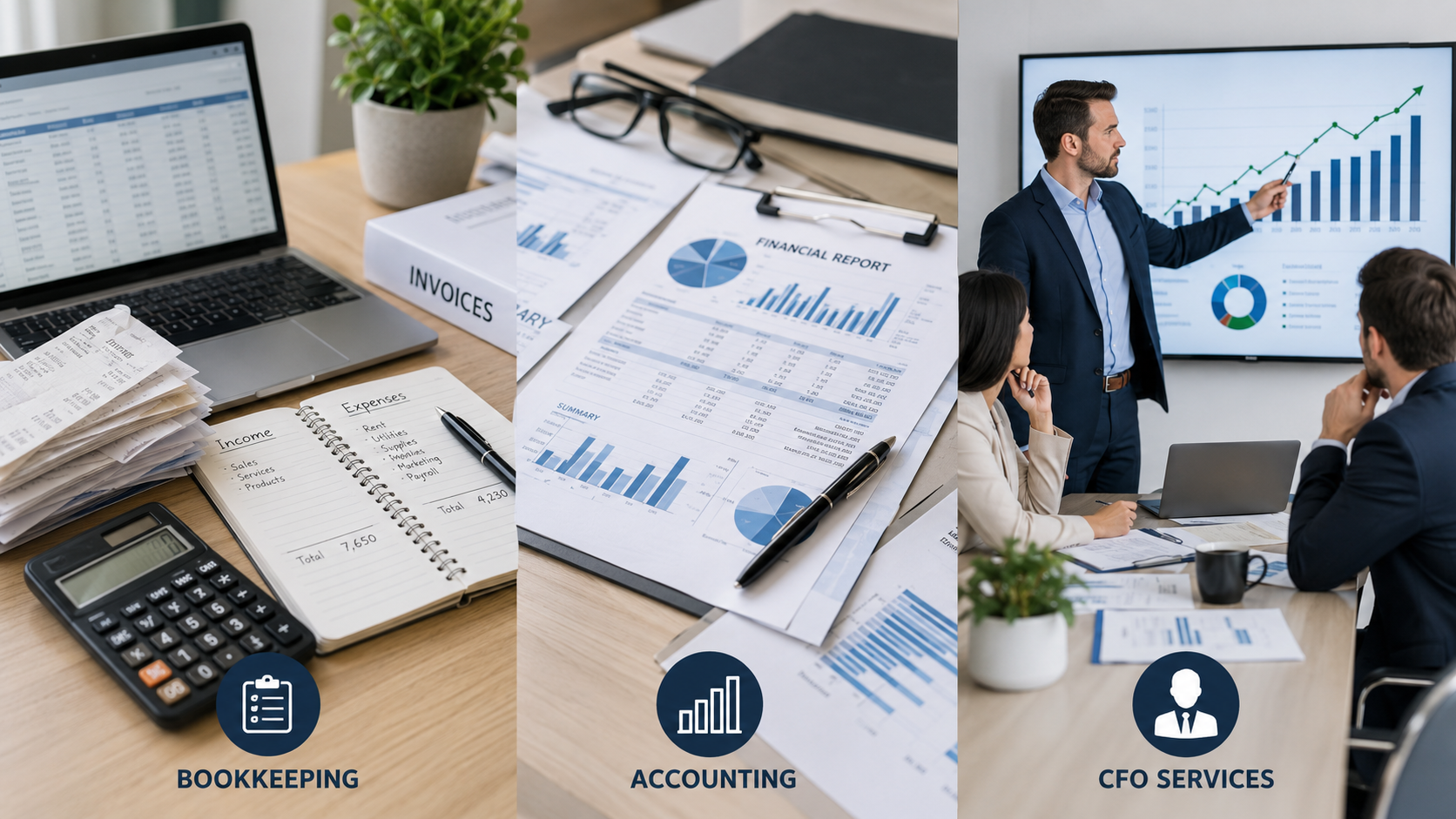
The Difference Between Bookkeeping, Accounting, and CFO Services: Which Does Your Business Need?
Running a successful business requires more than generating sales—it requires understanding your financial health. Many business owners hear the terms bookkeeping, accounting, and CFO services used interchangeably, but they each serve a very different purpose.
Knowing the distinction can help you make better financial decisions, improve profitability, stay compliant, and position your company for long-term growth. Whether you’re a startup, a growing small business, or an established company, understanding these services will help you invest in the right financial support at the right stage.
In this guide, we’ll explain what bookkeeping, accounting, and CFO services actually involve, how they differ, when your business needs each one, and why combining all three creates a strong financial foundation.
Understanding the Financial Pyramid
The easiest way to understand these services is to think of them as a pyramid.
- Bookkeeping forms the foundation by recording every financial transaction.
- Accounting organizes, analyzes, and reports the financial information.
- CFO Services use that information to make strategic business decisions.
Each level depends on the one beneath it. Without accurate bookkeeping, accounting reports become unreliable. Without reliable accounting, strategic CFO decisions become little more than educated guesses.
What Is Bookkeeping?
Bookkeeping is the process of recording, organizing, and maintaining your company’s financial transactions. It provides an accurate record of everything that happens financially within your business.
Bookkeeping focuses on the day-to-day movement of money rather than financial analysis.
Typical Bookkeeping Tasks
- Recording income and expenses
- Managing invoices
- Tracking customer payments
- Recording vendor bills
- Reconciling bank accounts
- Reconciling credit card statements
- Maintaining the general ledger
- Recording payroll transactions
- Categorizing expenses correctly
- Managing accounts payable and receivable
Bookkeepers ensure every transaction is recorded correctly and consistently.
Why Accurate Bookkeeping Matters
- Provides reliable financial records
- Prepares businesses for tax filing
- Helps prevent fraud
- Improves cash flow tracking
- Reduces accounting errors
- Saves time during audits
- Supports better financial reporting
Without accurate bookkeeping, every financial report produced afterward becomes less reliable.
What Is Accounting?
Accounting goes beyond recording transactions. Accountants interpret, analyze, and summarize financial data to help businesses understand performance and remain compliant with tax laws and regulations.
If bookkeeping records the story, accounting explains what the story means.
Typical Accounting Services
- Preparing financial statements
- Analyzing business performance
- Tax planning
- Tax preparation
- Financial reporting
- Budget development
- Cash flow analysis
- Cost analysis
- Financial forecasting
- Regulatory compliance
Common Financial Statements Produced by Accountants
Income Statement
Shows your revenues, expenses, and net profit over a specific period.
Balance Sheet
Provides a snapshot of assets, liabilities, and owner’s equity.
Cash Flow Statement
Tracks how money moves into and out of the business.
Statement of Retained Earnings
Shows how profits are reinvested into the business.
These reports help owners understand where the company stands financially.
What Are CFO Services?
CFO (Chief Financial Officer) services focus on strategic financial leadership rather than day-to-day bookkeeping or compliance accounting.
Instead of asking “What happened?” a CFO asks:
- Where is the company going?
- What financial risks exist?
- How can profits increase?
- How should cash be invested?
- What funding options are available?
- How should the company prepare for growth?
Many growing businesses don’t need a full-time CFO but still benefit from outsourced or fractional CFO services.
Typical CFO Responsibilities
- Strategic financial planning
- Cash flow forecasting
- Budget management
- Growth planning
- Business performance analysis
- Financial modeling
- Pricing strategy
- Investment planning
- Funding strategy
- Risk management
- Profitability analysis
- KPI monitoring
- Board reporting
- Business valuations
- Mergers and acquisitions support
Comparing Bookkeeping, Accounting, and CFO Services
Although these services work together, they each answer different financial questions.
| Service | Primary Focus | Main Goal |
|---|---|---|
| Bookkeeping | Recording transactions | Maintain accurate financial records |
| Accounting | Analyzing financial data | Report financial performance and ensure compliance |
| CFO Services | Strategic financial leadership | Improve profitability and guide business growth |
When Does a Business Need Bookkeeping?
Every business should have bookkeeping from day one.
Even sole proprietors need accurate records to:
- Track expenses
- Prepare taxes
- Monitor cash flow
- Avoid financial mistakes
- Support loan applications
Without bookkeeping, financial records quickly become disorganized, making tax season stressful and increasing the likelihood of costly errors.
When Does a Business Need Accounting?
Businesses typically need accounting services as soon as financial activity becomes more complex.
This often includes:
- Hiring employees
- Growing revenue
- Managing inventory
- Operating in multiple states
- Seeking financing
- Preparing tax returns
- Creating financial reports for investors
Accountants ensure financial information is accurate, compliant, and meaningful.
When Does a Business Need CFO Services?
Many owners assume CFO services are only for large corporations. In reality, many small and medium-sized businesses benefit from outsourced CFO support long before hiring a full-time executive.
You may need CFO services if:
- Your business is growing rapidly.
- Cash flow has become unpredictable.
- You’re preparing for investment.
- You’re expanding locations.
- You’re planning acquisitions.
- You need budgeting assistance.
- You want to improve profitability.
- You need financial forecasting.
- You’re making major capital investments.
How These Services Work Together
Think of the relationship as a financial workflow.
Step 1: Bookkeeping Records Everything
Every sale, expense, payroll transaction, invoice, and payment is accurately recorded.
Step 2: Accounting Organizes the Information
Accountants prepare reports, analyze profitability, calculate taxes, and explain financial performance.
Step 3: CFO Services Guide Decisions
CFOs use those reports to create strategies that improve profitability, reduce costs, increase cash flow, and support sustainable growth.
Common Misconceptions
Myth 1: Bookkeepers and Accountants Do the Same Job
While they work closely together, bookkeepers focus on recording transactions, while accountants interpret and analyze the resulting financial data.
Myth 2: Only Large Companies Need CFO Services
Fractional and outsourced CFO services have made executive-level financial guidance accessible and affordable for many small businesses.
Myth 3: Accounting Only Matters During Tax Season
Accounting supports decision-making throughout the year, not just during tax filing.
Myth 4: Software Replaces Financial Professionals
Accounting software automates many tasks, but it cannot replace professional judgment, strategic planning, or expert financial advice.
The Benefits of Combining All Three Services
Businesses that integrate bookkeeping, accounting, and CFO services gain a complete financial management system.
Benefits include:
- Better financial visibility
- Improved cash flow
- Higher profitability
- Accurate budgeting
- Reduced tax surprises
- Faster financial reporting
- Improved compliance
- Smarter growth decisions
- Greater investor confidence
- Reduced financial risk
Signs Your Business Has Outgrown Basic Bookkeeping
If your business experiences any of the following, it may be time to expand your financial support:
- Revenue continues to increase each year.
- You struggle to understand financial reports.
- Cash flow problems occur despite strong sales.
- You are hiring multiple employees.
- You need financing from lenders.
- You are opening additional locations.
- You spend too much time managing finances yourself.
- You lack reliable financial forecasts.
How Technology Supports Modern Financial Services
Today’s financial professionals leverage cloud-based accounting software and automation tools to improve accuracy and efficiency.
Modern solutions allow businesses to:
- Access financial reports in real time
- Automate recurring transactions
- Digitize receipts and invoices
- Integrate payroll systems
- Monitor cash flow continuously
- Collaborate securely with advisors from anywhere
However, technology is most effective when paired with experienced professionals who can interpret the data and provide strategic guidance.
Choosing the Right Financial Partner
When selecting a financial services provider, consider more than just compliance. Look for a partner who understands your industry, communicates clearly, and can scale services as your business grows.
A trusted advisor should be able to provide:
- Reliable bookkeeping
- Comprehensive accounting services
- Tax planning and compliance
- Financial reporting
- Strategic CFO guidance
- Business consulting
- Growth planning
Working with one firm that offers integrated financial services can improve consistency, reduce communication gaps, and provide a clearer picture of your business’s financial health.
How Lampkin CPA Advisors Can Help
At Lampkin CPA Advisors, we provide comprehensive financial solutions designed to support businesses at every stage of growth. From maintaining accurate books to delivering insightful financial reports and strategic CFO guidance, our team helps business owners make confident, data-driven decisions.
Whether you need dependable bookkeeping services, professional accounting support, tax planning, or outsourced CFO expertise, we tailor our services to meet your unique business goals. By integrating these functions under one trusted advisor, you gain greater visibility into your finances, stronger cash flow management, and a roadmap for sustainable growth.
Conclusion
Bookkeeping, accounting, and CFO services are not competing functions—they are complementary layers of effective financial management. Bookkeeping creates accurate records, accounting transforms those records into meaningful financial insights, and CFO services use those insights to drive smarter business decisions.
As your business grows, so do your financial needs. Investing in the right combination of services can improve operational efficiency, strengthen compliance, enhance profitability, and prepare your company for future opportunities.
If you’re ready to build a stronger financial foundation, contact Lampkin CPA Advisors to learn how our integrated bookkeeping, accounting, and CFO services can help your business thrive.