
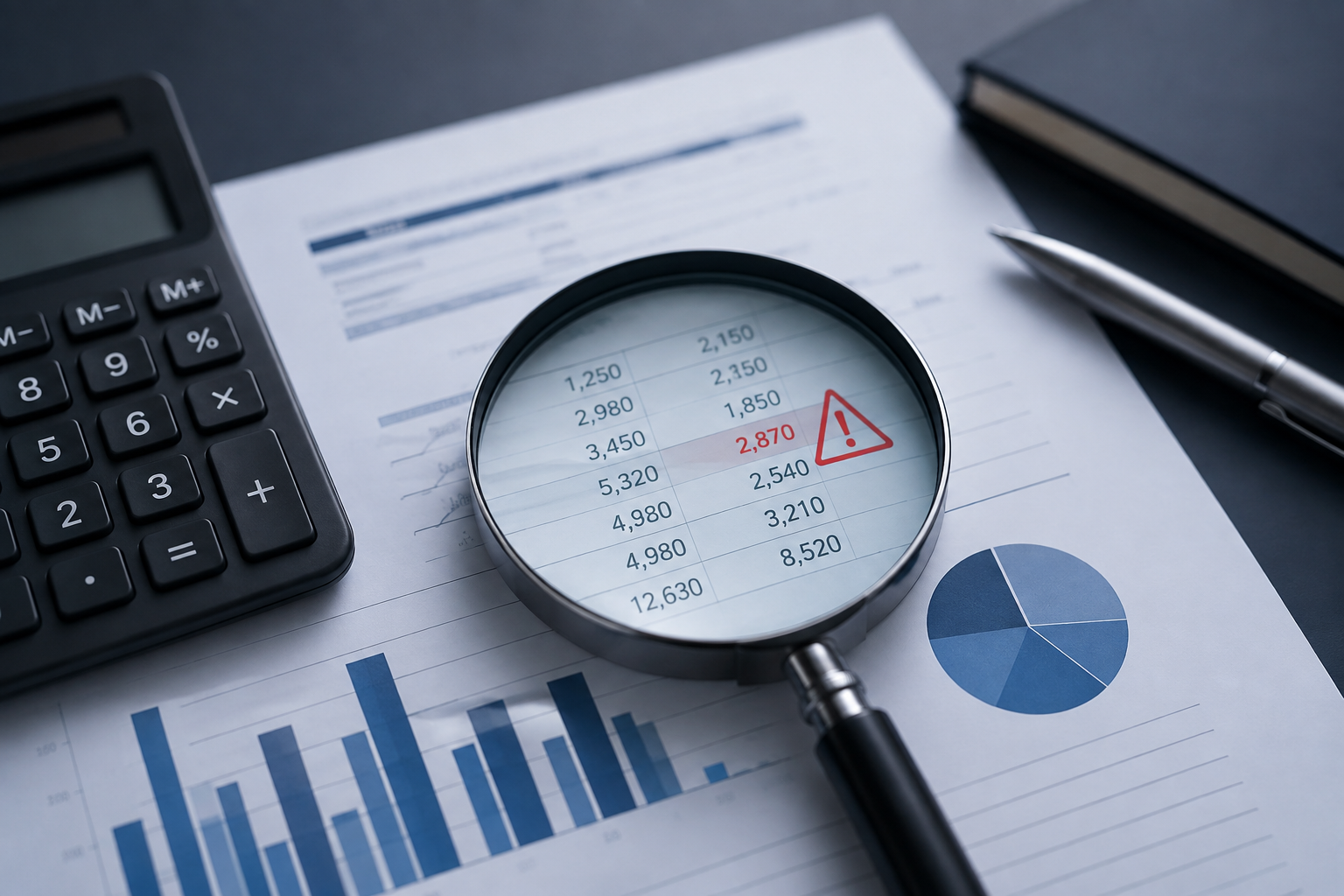
How Accountants Use Patterns to Detect Financial Mistakes
Financial mistakes are not always obvious. A transaction may be recorded twice, posted to the wrong account, entered with the wrong amount, or omitted entirely. On their own, these errors can be difficult to spot, especially in a business that processes hundreds or thousands of transactions every month.
That is why accountants do not simply look at financial records one transaction at a time. They also look for patterns.
Patterns can reveal what appears normal, consistent, and expected within a set of financial data. When something breaks that pattern, it may indicate a mistake that requires further investigation. A sudden increase in an expense account, an unusual journal entry, a duplicate invoice number, or a customer balance that behaves differently from previous periods can all act as warning signs.
Understanding how accountants use patterns to detect financial mistakes is useful for business owners, finance professionals, and anyone responsible for maintaining reliable accounting records. Pattern analysis helps transform large amounts of financial information into something more manageable by making unusual activity easier to identify.
This article explains how accountants recognise financial patterns, identify anomalies, compare current figures with historical data, and investigate transactions that do not appear to follow normal financial behaviour.
Why Patterns Matter in Accounting
Accounting records are built from repeated activities. Businesses regularly make sales, pay suppliers, receive invoices, process payroll, collect customer payments, purchase inventory, and record expenses. Because many of these activities happen repeatedly, they often create recognisable financial patterns.
For example, a business may normally spend approximately the same amount on rent every month. Payroll expenses may follow a predictable pattern based on the number of employees and their salaries. Sales may increase during certain seasons and decrease during quieter periods.
When accountants understand these normal patterns, they are in a stronger position to identify figures that appear unusual.
An unusual figure does not automatically mean that an accounting mistake has occurred. A business may have experienced a legitimate increase in costs, made an unexpected purchase, or received an unusually large customer payment. However, an amount that differs significantly from the expected pattern gives the accountant a reason to investigate.
Pattern recognition therefore acts as an early warning system. Instead of assuming that every figure is correct because it has been entered into the accounting system, accountants compare information with what they would reasonably expect to see.
This approach can make financial reviews more efficient. Rather than treating every transaction as equally suspicious, accountants can focus their attention on records that differ from established patterns.
What Is a Financial Pattern?
A financial pattern is a repeated or predictable relationship within accounting data. It may relate to the timing, amount, frequency, classification, or behaviour of transactions. For example, a business that pays its office rent on the first day of every month is creating a timing pattern. A company that normally records similar monthly utility costs is creating an amount pattern. A customer that regularly pays invoices within 30 days is creating a payment behaviour pattern.
Accountants can analyse patterns across many different areas of the financial records. Some of the most useful patterns involve recurring transactions, account balances, ratios, transaction frequencies, seasonal movements, and relationships between related accounts.
The key principle is relatively simple: accountants first establish what appears normal and then investigate information that does not fit.
This does not necessarily require complicated technology. An experienced accountant may recognise an unusual figure simply because it does not make sense compared with previous financial periods. At the same time, modern accounting software, spreadsheets, and data analysis tools can help identify patterns across much larger volumes of information.
Comparing Current Figures With Previous Periods
One of the most common ways accountants detect financial mistakes is by comparing current financial information with previous periods.
Suppose a business normally reports monthly electricity expenses between £2,000 and £2,500. If the latest accounting records show an electricity expense of £25,000, the figure immediately deserves attention.
There may be a legitimate explanation. Perhaps the business moved into a larger property, received several months of invoices at once, or paid an overdue balance. However, there may also be an accounting error.
The invoice may have been entered with an extra zero. A decimal point may have been placed incorrectly. The same invoice may have been recorded multiple times. Alternatively, a completely unrelated transaction may have been posted to the electricity expense account.
Comparing current figures with historical data makes these possibilities easier to identify.
Accountants may compare information on a monthly, quarterly, or annual basis depending on the nature of the business. Some companies also compare current results with the same period from the previous year because seasonal businesses may experience predictable changes throughout the year. For example, comparing December sales with November sales may not provide much useful information for a business that experiences a significant Christmas trading period. Comparing December sales with December from previous years may provide a more meaningful pattern.
Historical comparisons can therefore help accountants distinguish between expected changes and potentially incorrect figures.
Looking for Unusual Increases or Decreases
A sudden increase or decrease in an account balance is often one of the first signs that accountants investigate.
Imagine that advertising expenses have remained relatively stable for several months. If the balance suddenly doubles without an obvious reason, the accountant may review the transactions recorded within the account.
The investigation may reveal a genuine marketing campaign. However, it could also identify an invoice that was accidentally entered twice or a transaction that was incorrectly classified as advertising.
Unexpected decreases can be equally important. If an expense account suddenly falls significantly, it may indicate that an invoice has not been recorded or that a transaction has been posted to the wrong account.
Accountants therefore pay attention to both positive and negative movements. The question is not simply whether an account has increased or decreased. The more important question is whether the movement makes sense based on what is happening within the business.
This type of review is particularly useful when preparing monthly management accounts. Regular financial reviews make it easier to identify unusual movements before they remain hidden in the accounting records for an extended period.
Using Expected Relationships Between Accounts
Financial accounts often have relationships with one another. When those relationships change unexpectedly, accountants may investigate further. For example, a business that experiences a significant increase in sales may reasonably expect some related accounts to increase as well. Depending on the nature of the business, this could include cost of sales, inventory purchases, VAT liabilities, or trade receivables.
If sales increase dramatically while every related account remains unchanged, the figures may deserve closer examination.
Similarly, a company may expect depreciation expense to follow a relatively predictable pattern based on the assets it owns and the depreciation methods it uses. A sudden change could indicate that an asset has been incorrectly recorded, disposed of incorrectly, or depreciated using the wrong calculation.
Accountants often use these relationships as a reasonableness check.
Rather than examining an account in isolation, they consider whether the financial information works together logically. Financial statements are connected, and mistakes in one area can sometimes create unusual patterns elsewhere.
Understanding these connections is one reason why accurate bookkeeping and regular financial review are so important. Professional accounting support can help businesses identify inconsistencies before they become larger reporting problems. Businesses looking for assistance with financial records and accounting processes can learn more through Lampkin CPA Advisors.
Detecting Duplicate Transactions
Duplicate transactions are a common source of financial mistakes. They can occur when an invoice is entered twice, a bank transaction is imported more than once, or two employees process the same payment without realising that the transaction has already been recorded.
Patterns can make duplicate transactions easier to identify.
Accountants may look for transactions with matching dates, amounts, supplier names, invoice numbers, or reference numbers. A single matching detail may not be enough to prove that a transaction is duplicated, but several matching characteristics can create a strong reason to investigate.
For example, two supplier invoices may have the same supplier name and the same amount but different invoice numbers. This may be completely legitimate. However, if both transactions have the same supplier, amount, date, invoice number, and description, a duplicate entry becomes much more likely.
Accounting software can assist with this process by flagging potential duplicates, but accountants still need to review the information. Two transactions that appear identical may occasionally represent legitimate separate purchases.
The goal is not simply to remove every repeated transaction. The goal is to understand why the pattern exists and determine whether the financial records accurately reflect what actually happened.
Recognising Repeated Data Entry Errors
Some accounting mistakes do not happen only once. They may be repeated over time because of a misunderstanding, incorrect process, or system configuration.
For example, an employee may consistently post a particular type of expense to the wrong general ledger account. The individual transactions may appear reasonable when reviewed separately, but a pattern may emerge when the accountant examines the account over several months.
Repeated errors can be especially important because they may affect multiple financial reporting periods.
Suppose travel expenses have consistently been posted to office expenses. The total financial statements may still balance, meaning that a simple review of the trial balance may not immediately reveal the problem. However, a detailed analysis of the account could show an unusual concentration of travel-related descriptions.
Once the pattern is identified, the accountant can correct the classification and review whether the same mistake occurred in previous transactions.
This demonstrates an important principle in accounting: a pattern can reveal not only that an error exists but also how widespread the error may be.
Using Ratios to Identify Financial Anomalies
Financial ratios can also help accountants identify patterns that may indicate mistakes.
A ratio compares two related financial figures and can provide a clearer view of business performance than examining individual amounts alone.
For example, gross profit margin compares gross profit with revenue. If a business normally maintains a relatively consistent margin but suddenly reports a significant change, the accountant may investigate.
The change could be legitimate because of pricing decisions, supplier cost increases, discounts, or changes in the product mix. However, it could also indicate that revenue or cost of sales has been recorded incorrectly.
Other useful relationships may involve inventory turnover, accounts receivable, accounts payable, operating expenses, and cash balances.
Ratios are particularly useful because they can identify unusual relationships even when the individual account balances appear reasonable. A revenue figure may look similar to previous periods, and an expense figure may also look normal, but the relationship between them may reveal something unexpected.
This allows accountants to move beyond asking whether a number looks unusual and instead ask whether the numbers make sense together.
Identifying Transactions That Occur at Unusual Times
Timing is another important financial pattern.
Businesses often have predictable transaction cycles. Suppliers may be paid on specific dates. Payroll may be processed weekly or monthly. Customer invoices may be raised at the end of each month.
When a transaction occurs outside the normal pattern, accountants may investigate the reason.
For example, a large payment made late at night, during a holiday period, or on a date when the business normally processes very few transactions may deserve additional review.
Again, unusual timing does not automatically mean that the transaction is incorrect. Emergency payments, international transactions, and automated systems can all produce activity outside normal business hours.
However, the timing pattern provides context. A transaction that is unusual in both amount and timing may deserve greater attention than one that differs in only one area.
By combining multiple patterns, accountants can develop a clearer understanding of which transactions represent genuine financial activity and which may require investigation.
Finding Missing Transactions Through Pattern Analysis
Pattern recognition is not only useful for finding transactions that should not exist. It can also help accountants identify transactions that are missing.
For example, a business may receive a monthly invoice from a supplier. If eleven invoices have been recorded during the year instead of twelve, the missing month may indicate that an invoice has not yet been entered.
Similarly, payroll expenses may normally appear every month. If the payroll account contains no entry for a particular period, the accountant can investigate whether the expense was omitted, recorded elsewhere, or processed incorrectly.
Bank reconciliations also depend heavily on identifying missing information. Accountants compare transactions recorded in the accounting system with transactions appearing on bank statements.
If a pattern of regular bank charges or payments suddenly disappears from the accounting records, the missing transaction may need to be identified and recorded.
Missing transactions can be particularly problematic because they may be harder to notice than obviously incorrect entries. A transaction that does not exist in the records cannot be found simply by reviewing the list of recorded transactions.
Patterns help create an expectation of what should be present, making omissions easier to detect.
Comparing Budgeted and Actual Results
Budgets and forecasts provide another useful benchmark for identifying financial mistakes.
When accountants compare actual results with budgeted figures, significant differences may indicate changes in business performance, but they may also reveal accounting issues.
Suppose a company has budgeted £10,000 for a particular monthly expense, but the accounting system reports £100,000. The difference immediately raises questions.
The budget may have been inaccurate, or the business may have experienced an unexpected event. However, the accountant may also discover that a decimal point was entered incorrectly or that several transactions were posted to the wrong account.
Variance analysis helps accountants focus on significant differences rather than reviewing every account with equal attention.
This is particularly valuable for growing businesses with increasing volumes of financial activity. As the number of transactions increases, systematic review processes become more important for maintaining reliable records.
Using Bank Reconciliations to Identify Patterns and Errors
Bank reconciliation is one of the most practical examples of pattern-based accounting review.
A bank account creates a detailed record of money entering and leaving the business. Accountants compare this information with the transactions recorded in the accounting system to identify differences.
Over time, reconciliation also creates patterns.
A business may regularly receive customer payments, pay particular suppliers, incur monthly bank charges, or process recurring direct debits. When an expected transaction is missing or an unfamiliar transaction appears, the difference may require investigation.
Unreconciled items can reveal a range of issues, including:
- Transactions recorded twice.
- Payments entered with incorrect amounts.
- Deposits recorded in the wrong period.
- Bank charges that have not been recorded.
- Transactions posted to the wrong bank account.
- Payments or receipts that have been omitted.
Regular bank reconciliations help prevent these issues from remaining hidden for long periods. The longer an accounting error remains undiscovered, the more difficult it may become to trace its source.
Businesses that want to strengthen their bookkeeping and financial review processes can explore professional accounting support through Lampkin CPA Advisors.
How Accountants Investigate an Unusual Pattern
Identifying an unusual pattern is only the beginning of the process. Accountants then need to determine why the difference occurred.
The investigation usually begins by reviewing the transactions behind the account balance. Instead of looking only at the final figure on the financial statement, the accountant traces the amount back to individual journal entries, invoices, receipts, bank transactions, or other supporting documents.
For example, if an expense account has increased unexpectedly, the accountant may review the largest transactions first. A single incorrectly entered transaction may explain the entire difference.
If no obvious error is found, the accountant may compare transaction dates, descriptions, reference numbers, suppliers, and users who entered the information.
This process can help answer important questions. Was the transaction authorised? Does supporting documentation exist? Was the correct amount recorded? Was it posted to the correct account? Has the same transaction been entered elsewhere?
In some cases, the unusual pattern may have a completely legitimate explanation. In others, the investigation may reveal an accounting mistake that needs to be corrected.
The important point is that accountants do not automatically assume that unusual means incorrect. They investigate the reason behind the pattern.
The Role of Spreadsheets and Accounting Software
Technology has made it easier to identify patterns within large volumes of financial information.
Spreadsheets can be used to sort transactions, compare periods, identify duplicate values, calculate variances, and analyse changes over time. A well-structured spreadsheet can quickly highlight transactions that fall outside an expected range.
Accounting software can also automate many routine processes. Bank feeds, recurring transaction rules, reconciliation tools, reporting dashboards, and automated alerts can help accountants monitor financial activity more efficiently.
However, technology does not completely replace professional judgement.
A software system may identify an unusual transaction, but it cannot always determine whether that transaction is genuinely incorrect. The accountant still needs to understand the business, review the available evidence, and decide whether an adjustment is necessary.
The most effective approach combines technology with human analysis. Software can process large amounts of information quickly, while accountants provide the judgement needed to understand why a pattern exists.
Why Understanding the Business Is Important
Patterns are only meaningful when they are considered within the context of the business.
A sudden increase in sales may appear unusual when compared with previous months, but it may be completely expected for a seasonal business. A large increase in inventory purchases may reflect expansion rather than an accounting mistake.
Accountants therefore need to understand how the business operates.
Knowledge of the company’s industry, customers, suppliers, business cycles, pricing, and operational changes helps accountants interpret financial information more accurately.
This is why financial analysis involves more than simply identifying numbers that differ from an average. A figure can be statistically unusual while still being completely legitimate.
Professional judgement helps distinguish between a genuine business event and a financial mistake.
Patterns Can Reveal Small Errors Before They Become Bigger Problems
Many financial mistakes begin as relatively small problems. A transaction may be posted to the wrong account, an invoice may be duplicated, or an amount may be entered incorrectly.
If the mistake is identified quickly, correcting it may be straightforward.
However, errors can become more complicated when they continue through multiple accounting periods. Incorrect account balances may affect management reports, tax calculations, financial statements, budgets, and business decisions.
Regular pattern analysis helps accountants identify unusual activity before it develops into a larger issue.
For example, monthly comparisons can reveal an incorrect expense shortly after it is recorded. Regular reconciliations can identify missing or duplicated transactions before the year-end. Budget comparisons can highlight unusual movements while there is still time to investigate them.
Consistent financial review is therefore an important part of maintaining accurate records.
Creating a Stronger Financial Review Process
Businesses do not need to wait until the end of the financial year to search for accounting mistakes.
A stronger review process involves regularly examining financial information and comparing results with expected patterns.
This may include reviewing significant account movements, reconciling bank accounts, comparing actual performance with budgets, checking unusual transactions, and investigating accounts that behave differently from previous periods.
The frequency of these reviews depends on the size and complexity of the business. A small business may conduct detailed reviews monthly, while larger organisations may monitor key financial information much more frequently.
Consistency is important. A pattern is easier to identify when financial information is reviewed regularly.
Businesses should also maintain clear documentation and reliable accounting processes. When supporting documents are organised and transactions are recorded consistently, investigating an unusual pattern becomes significantly easier.
How Professional Accountants Help Identify Financial Mistakes
Professional accountants bring both technical knowledge and experience to the process of reviewing financial information.
They understand how transactions should flow through the accounting system, how accounts relate to one another, and which changes may require further investigation.
An accountant may identify an issue simply because a figure does not fit the expected financial pattern. From there, they can trace the transaction back through the accounting records and supporting documentation to determine the source of the difference.
This can help businesses improve the accuracy of their financial records and develop stronger accounting procedures for the future.
Professional accounting support can be particularly valuable for businesses that are growing, processing larger volumes of transactions, or finding it increasingly difficult to maintain accurate financial records internally.
Working with experienced financial professionals can provide additional oversight and help businesses gain a clearer understanding of their financial information. To learn more about accounting and advisory support, visit Lampkin CPA Advisors.
Common Examples of Financial Patterns That May Reveal Mistakes
Financial patterns can appear in almost every part of an accounting system.
A supplier invoice that appears twice may indicate a duplicate entry. A monthly expense that suddenly increases by an unusual amount may reveal a data entry error. A recurring payment that disappears may indicate an omitted transaction.
A customer account that normally maintains a consistent payment pattern may suddenly contain an unusually old balance. This could indicate a collection issue, but it could also reveal that a payment has been applied incorrectly.
An account that contains a large number of small adjustments may suggest that an underlying process is not working correctly. A sudden increase in manual journal entries may also indicate that financial records are being corrected repeatedly rather than addressing the original source of the problem.
These examples demonstrate why accountants look beyond individual numbers. The behaviour of financial information over time can provide valuable clues.
The Difference Between Pattern Recognition and Guessing
Pattern recognition does not mean making assumptions without evidence.
An accountant may notice that a figure looks unusual, but that observation is only the starting point. The next step is to investigate the available records and determine whether there is a valid explanation.
For example, a sudden increase in travel expenses may initially appear suspicious. However, supporting documentation may show that the company attended an important industry event or sent employees on a legitimate business trip.
The financial pattern identifies the transaction as unusual. The evidence determines whether it is incorrect.
This distinction is important because businesses naturally experience changes. A good accounting review process should identify genuine mistakes without treating every unusual business event as an error.
Why Accurate Financial Data Supports Better Decisions
Detecting financial mistakes is not only about ensuring that the books balance.
Business owners and managers rely on financial information when making decisions about spending, hiring, pricing, investment, growth, and cash flow.
If the underlying financial data contains mistakes, those decisions may be based on inaccurate information.
Pattern analysis helps improve confidence in financial reporting by creating regular opportunities to identify inconsistencies and investigate unexpected results.
For example, if a business appears to be spending significantly more than expected, identifying the reason behind that pattern is essential. The increase may represent genuine business costs, or it may be caused by duplicated invoices or incorrect data entry.
Without investigation, management may make decisions based on the assumption that the financial information is correct.
Reliable accounting records provide a stronger foundation for understanding business performance.
Final Thoughts: Patterns Turn Financial Data Into Useful Clues
Financial records contain far more information than individual transaction amounts. When accountants analyse transactions over time, they can identify recurring behaviour, expected relationships, unusual movements, and missing information.
These patterns can reveal potential financial mistakes that may not be obvious when each transaction is reviewed in isolation.
A duplicate payment, an incorrectly entered amount, a missing invoice, or a transaction posted to the wrong account can all disrupt the normal patterns within a company’s financial records.
The accountant’s role is to recognise those disruptions, investigate the underlying transactions, and determine whether the difference represents a genuine business event or an accounting mistake.
Regular financial reviews, reconciliations, comparisons, and professional analysis can help businesses identify errors earlier and maintain more reliable records.
Ultimately, accountants use patterns because financial mistakes rarely exist in complete isolation. An incorrect transaction often leaves a trace somewhere in the financial data. By understanding what normal financial behaviour looks like, accountants are better equipped to find the numbers, transactions, and relationships that do not belong.
For businesses seeking guidance with bookkeeping, financial analysis, accounting processes, or maintaining reliable financial records, Lampkin CPA Advisors can provide professional accounting and advisory support.