
“`html
What Is an Accounting Close and Why Does It Matter?
The accounting close is one of the most important financial processes for any business, regardless of its size or industry. Every month, quarter, and year, businesses must review their financial records, verify transactions, reconcile accounts, and ensure that financial statements accurately reflect the company’s performance. This structured process is known as the accounting close or financial close.
Although many business owners think of accounting as something that only matters during tax season, maintaining an accurate and timely accounting close provides valuable insights throughout the year. It helps leaders make informed decisions, identify financial issues early, improve cash flow management, and maintain compliance with accounting standards and tax regulations.
Without a proper accounting close, financial reports become unreliable. Management may base important business decisions on inaccurate information, lenders may lose confidence, investors may question financial health, and tax filings become more difficult.
What Is an Accounting Close?
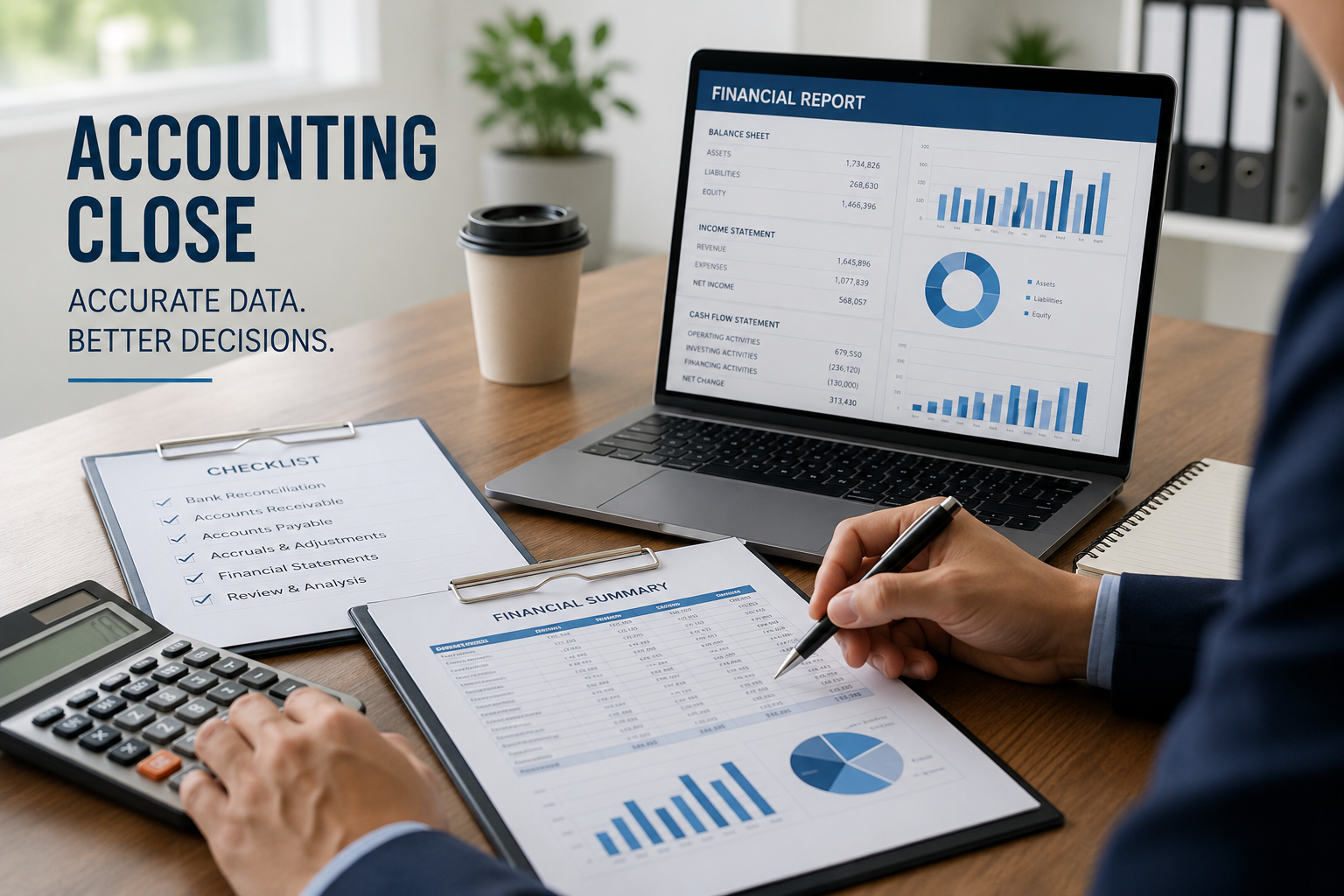
An accounting close is the systematic process of reviewing, reconciling, and finalizing a company’s financial records for a specific accounting period. Most businesses perform a monthly accounting close, while quarterly and annual closes involve additional reporting and compliance requirements.
During the accounting close, accountants verify that every financial transaction has been accurately recorded before financial statements are prepared.
The objective is simple: ensure that the company’s financial reports accurately represent its financial position and operating performance.
A completed accounting close typically results in finalized:
- Income statements
- Balance sheets
- Cash flow statements
- General ledger balances
- Supporting schedules
- Management reports
These reports become the foundation for budgeting, forecasting, tax planning, financing decisions, and strategic growth initiatives.
Why Does the Accounting Close Matter?
The accounting close is much more than an administrative task. It provides confidence that financial information is complete, accurate, and useful.
Business owners rely on these reports to understand profitability, monitor expenses, manage cash flow, and evaluate business performance. If the financial data is incorrect, every decision based on that data becomes less reliable.
A well-managed accounting close allows businesses to:
- Make informed business decisions
- Identify financial trends earlier
- Detect fraud or accounting errors
- Improve budgeting accuracy
- Prepare for tax obligations
- Meet lender and investor reporting requirements
- Maintain compliance with accounting standards
In contrast, delayed or inaccurate closes often create confusion, increase costs, and make it difficult to understand the true financial condition of the business.
The Main Steps in an Accounting Close
Although every business has unique accounting needs, most accounting close processes follow a similar sequence.
1. Record All Financial Transactions
Every invoice, expense, payroll transaction, customer payment, bank transaction, loan payment, and journal entry should be entered into the accounting system before the close begins.
Missing transactions lead directly to inaccurate financial statements.
2. Reconcile Bank Accounts
Bank reconciliation compares the accounting records with actual bank statements to ensure every transaction matches.
Differences may include:
- Outstanding checks
- Deposits in transit
- Bank fees
- Interest income
- Duplicate transactions
- Recording errors
Reconciling accounts helps identify mistakes before financial reports are finalized.
3. Reconcile Credit Card Accounts
Business credit cards should also be reconciled against monthly statements.
This confirms:
- All purchases are legitimate.
- Expenses are categorized correctly.
- Missing receipts are identified.
- Employee spending follows company policy.
4. Review Accounts Receivable
Outstanding customer invoices are reviewed to determine which balances remain unpaid.
Businesses often use this stage to:
- Send payment reminders
- Review overdue balances
- Record bad debt allowances
- Improve collections
Healthy accounts receivable directly support stronger cash flow.
5. Review Accounts Payable
Vendor invoices should be verified to ensure all expenses have been recorded before the period ends.
This prevents understated expenses and unexpected liabilities in future reporting periods.
6. Record Accruals and Adjustments
Many transactions occur before or after cash changes hands.
Accountants record adjusting entries for:
- Accrued expenses
- Accrued revenue
- Depreciation
- Amortization
- Prepaid expenses
- Inventory adjustments
These adjustments ensure financial statements comply with the matching principle under accrual accounting.
7. Review Payroll
Payroll expenses, taxes, employee benefits, retirement contributions, bonuses, and commissions should all be verified before closing the books.
Payroll is often one of the largest expenses for many businesses, making accuracy essential.
8. Verify Fixed Assets
Businesses review equipment, vehicles, furniture, technology, and buildings to ensure depreciation has been properly recorded.
Purchases and disposals should also be reflected correctly.
9. Review Financial Statements
Once reconciliations and adjustments are complete, management reviews key financial reports.
These include:
- Profit and loss statement
- Balance sheet
- Cash flow statement
- Budget comparisons
- Department performance reports
Unexpected fluctuations are investigated before reports are finalized.
10. Close the Accounting Period
Once all reviews are complete, the accounting period is officially closed, preventing unauthorized changes and preserving the accuracy of financial records.
Monthly Close vs Quarterly Close vs Year-End Close
Although the accounting close follows similar principles throughout the year, each reporting period serves a different purpose.
Monthly Close
Provides timely financial information that helps management monitor business performance and make operational decisions.
Quarterly Close
Often includes more detailed analysis, forecasting updates, tax estimates, and financial reporting for lenders or investors.
Year-End Close
The year-end close is the most comprehensive process because it prepares the business for annual tax filings, financial statements, audits, and strategic planning for the coming year.
Benefits of a Timely Accounting Close
Completing the accounting close quickly and accurately provides significant advantages beyond regulatory compliance.
Better Decision Making
Current financial information allows leaders to react quickly to market changes, control costs, and seize growth opportunities.
Improved Cash Flow Management
Accurate reporting highlights cash shortages, slow-paying customers, and unnecessary spending before they become major problems.
Greater Financial Accuracy
Routine reconciliation reduces accounting errors that can compound over time.
Reduced Audit Risk
Businesses with organized financial records experience smoother audits and spend less time responding to auditor requests.
Easier Tax Preparation
Well-maintained books make tax preparation significantly easier while reducing the likelihood of costly mistakes.
Common Accounting Close Challenges
Many organizations struggle to complete their accounting close efficiently.
Some of the most common challenges include:
- Missing documentation
- Delayed expense reporting
- Manual spreadsheets
- Poor communication between departments
- Bank reconciliation delays
- Incomplete inventory records
- Late vendor invoices
- Insufficient staffing
These issues often extend closing timelines and reduce confidence in financial reports.
How Technology Improves the Accounting Close
Modern accounting software has transformed the financial close process.
Automation reduces repetitive tasks while improving accuracy and efficiency.
Today’s accounting platforms can automate:
- Bank feeds
- Invoice processing
- Expense categorization
- Recurring journal entries
- Financial reporting
- Account reconciliations
- Approval workflows
Automation allows accounting professionals to spend more time analyzing financial performance rather than manually entering transactions.
Best Practices for an Efficient Accounting Close
Businesses can improve their close process by following several proven best practices.
Create a Closing Checklist
A standardized checklist ensures every important task is completed consistently each month.
Set Internal Deadlines
Waiting until the end of the month often causes unnecessary delays. Establish deadlines for invoices, expense reports, payroll approvals, and reconciliations.
Review Financial Reports Regularly
Monthly financial reviews allow issues to be identified before they become major problems.
Reduce Manual Processes
Automation improves efficiency while reducing human error.
Keep Documentation Organized
Maintaining digital records of invoices, receipts, contracts, and bank statements makes reconciliations significantly easier.
Work With Experienced Accounting Professionals
Professional accountants can identify inefficiencies, improve reporting accuracy, and ensure compliance with changing accounting standards.
Why Small Businesses Should Prioritize the Accounting Close
Small businesses sometimes postpone monthly financial reviews because owners are busy managing daily operations. However, waiting until year-end to review financial records often creates unnecessary stress and limits opportunities to improve business performance.
A monthly accounting close provides visibility into revenue, expenses, profitability, and cash flow throughout the year. It also helps identify unusual transactions, detect bookkeeping errors, and support more accurate forecasting.
Businesses that maintain current financial records are generally better positioned to secure financing, attract investors, respond to economic changes, and plan for future growth.
Final Thoughts
An accurate accounting close is far more than an accounting requirement—it is a critical business management tool. By consistently reviewing financial records, reconciling accounts, recording adjustments, and producing reliable financial statements, businesses gain the clarity needed to make confident decisions.
Whether your company is a startup, a growing small business, or an established organization, investing in a disciplined accounting close process improves financial visibility, supports compliance, strengthens cash flow management, and reduces costly errors.
At Lampkin CPA Advisors, we help businesses streamline bookkeeping, improve financial reporting, and implement efficient accounting processes that support long-term success. Whether you need monthly accounting support, outsourced CFO services, tax planning, or strategic financial guidance, our experienced professionals are here to help you build a stronger financial foundation.
“`